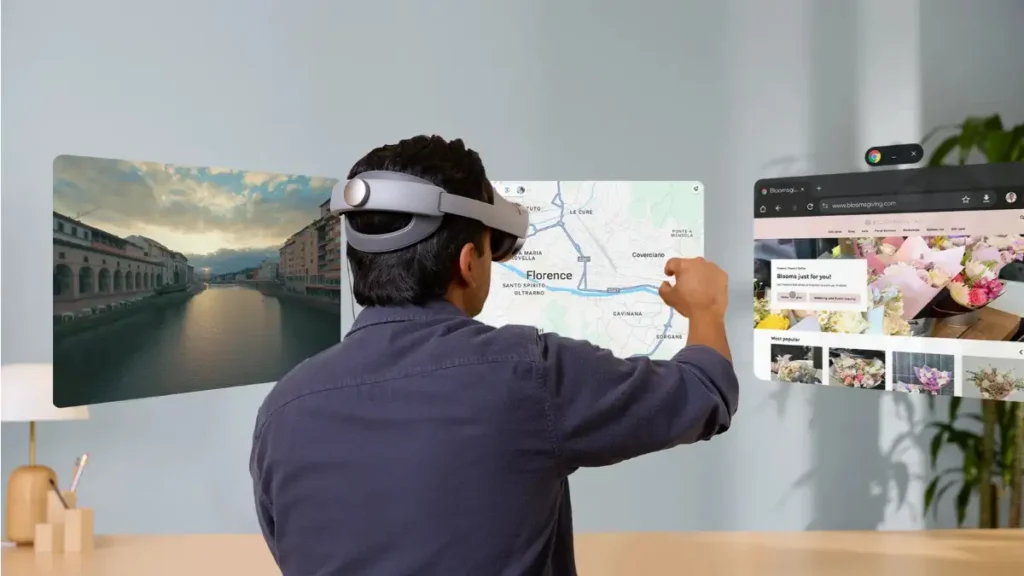
Apple just announced its Vision Pro refresh with the new M5 chip, but the timing couldn’t be worse. Because while Apple is focusing on $3,500 upgrades and high-end specs, Samsung and Google swooped in with a headset that actually matters to the rest of the world: the $1,799 Galaxy XR.
Dubbed internally as “Project Moohan”, the new Galaxy XR is the first device running on the Android XR platform. It’s a direct shot across the bow at Apple, delivering Vision Pro-like features at nearly half the price.
This isn’t a simple upgrade; it’s a full-scale assault on Apple’s attempt to dominate the spatial computing market. Let’s break down exactly why Samsung just won the price and power war 👇
💰 The Price War: Half the Cost, Full Experience
The biggest mic drop is the price. Samsung’s strategy is clear: build a highly capable, premium mixed-reality headset and make it accessible.
- Apple Vision Pro (M5 Refresh): Still starts at $3,500.
- Samsung Galaxy XR (Launch Price): Starts at just $1,799.
That $1,700 difference is a gulf that most consumers can’t ignore. Apple’s new M5 Vision Pro might be faster for AI, but Samsung’s is better for your wallet.
⚙️ Performance & Comfort: The Core Hardware Battle
This is where the fight gets interesting. Samsung isn’t relying on a watered-down chipset; they partnered with the giants to create a genuinely competitive device.
🧠 The Gemini AI Advantage
The headset runs the Android XR platform and features Gemini integrated at the system level.
- This integration allows for multimodal AI that manages tasks and enables natural interactions through voice, vision, and gesture.
- It functions as an “AI companion,” rather than a simple tool following commands.
While Apple’s new M5 chip and Apple Intelligence are certainly powerful, the Galaxy XR is powered by the Snapdragon XR2+ Gen 2, which is optimized for immersive experiences and advanced AI through its NPU (Neural Processing Unit).
🏋️ Weight, Battery, and Wearability
Samsung clearly paid attention to where Apple compromised on the original Vision Pro—comfort.
- Weight: At around 545 grams, the Galaxy XR is lighter than the refreshed M5 Vision Pro, which comes in at 600+ grams.
- Ergonomics: The Galaxy XR uses an ergonomically balanced frame to distribute pressure, minimizing facial discomfort.
- Battery: The battery pack is separate from the headset, making the device more compact, light, and comfortable to wear.
Samsung built a headset that is engineered to be light, comfortable, and cheaper.
🧩 Ecosystem: Open Platform vs. Walled Garden
This is the long-game killer. Apple’s Vision Pro is locked into its own ecosystem. The Galaxy XR is built on Android XR—an open, scalable ecosystem co-developed with Google and Qualcomm.
- App Development: It leverages the massive existing Android developer base for faster app adoption.
- Google Services: It offers deep integration with services like Gemini Assistant, YouTube Premium, and Google AI Pro via an Explorer Pass.
- Future-Proofing: The platform is designed to scale across a variety of form factors, including future AI glasses, ensuring that Android XR becomes the dominant operating system for mixed reality.
💬 Final Thoughts — Apple Just Lost the Mainstream
The new Apple Vision Pro is an incredible piece of engineering, but it is priced and designed as an enterprise tool for a niche audience.
The Samsung Galaxy XR is the true challenger because it delivered on the three things that matter most to the mainstream user:
- Affordability: Half the price of the Vision Pro.
- Comfort: Lighter with a better-designed battery and strap.
- Utility: Backed by the open-source strength of Google’s AI and Android XR.
Samsung and Google didn’t just launch a competitor; they launched the platform that will truly democratize spatial computing. Apple’s Vision Pro might be faster, but the Galaxy XR is the one that’s actually going to sell.

Pravin is a tech enthusiast and Salesforce developer with deep expertise in AI, mobile gadgets, coding, and automotive technology. At Thoughtsverser, he shares practical insights and research-driven content on the latest tech and innovations shaping our world.