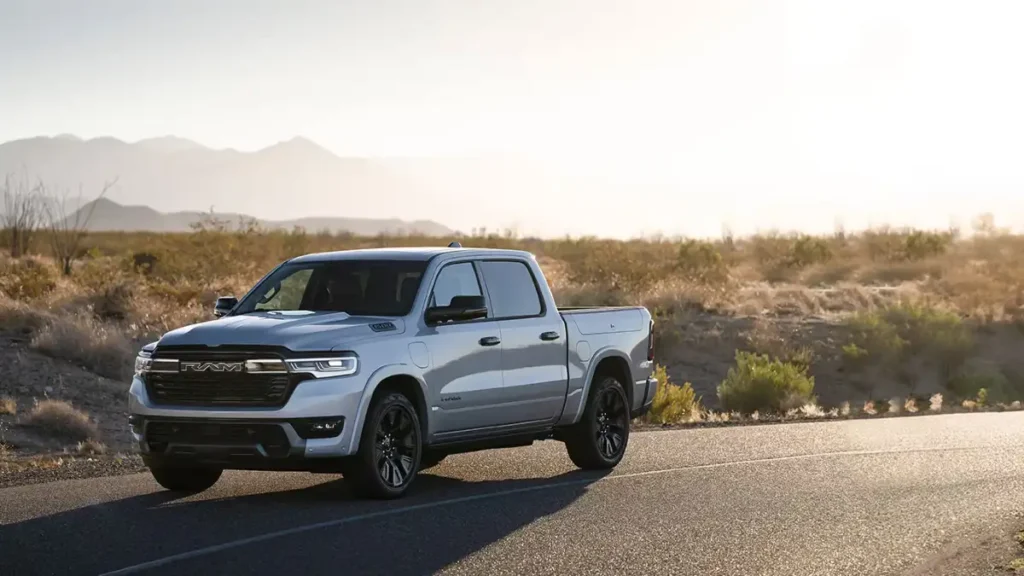
Ram has officially chickened out.
After months of delays and confusing name changes, Ram’s parent company, Stellantis, has confirmed they are discontinuing development of their planned battery-electric (BEV) Ram 1500 pickup. The all-electric rival to the Ford F-150 Lightning and the Cybertruck is dead before it even reached the showroom.
The official excuse? “Slowing demand for full-size battery-electric trucks in North America”.
This isn’t slowing demand—this is a spectacular failure of nerve. Ram is now banking entirely on its extended-range hybrid (plug-in V6) version, which it is controversially naming the Ram 1500 REV. It’s a desperate attempt to have an answer to the EV market without actually building one.
Let’s break down exactly what happened, and why this major industry decision exposes the dark truth about the so-called EV Truck War 👇
🛑 The Great Retreat: Why Ram Hit the Brakes
Ram’s highly anticipated all-electric pickup truck—originally introduced in 2023 as a concept—has been a confusing mess of delays and shifting product names. The final cancellation is a direct reflection of manufacturer jitters in a hyper-competitive market.
📉 The Slowing Demand Excuse is a Lie
While Stellantis is blaming “slowing demand”, the data is far more nuanced.
- Ford’s Success: Ford is still selling an impressive number of F-150 Lightnings, proving the demand for a capable electric workhorse is real.
- Segment Growth: Market strategists like Kelly Bluebook report that more EVs were sold in the U.S. in recent months than ever before, with nearly 10% of new cars being electric.
Ram’s decision isn’t about weak market demand; it’s about Ram’s inability to compete with the established players without a game-changing, 800-volt architecture or superior battery technology.
🌪️ H3: The Name Swap Confusion
To make matters worse, Ram is now slapping the “REV” name—the title originally given to the all-electric version—onto its extended-range hybrid truck (the one with the V6 engine).
This is a classic marketing bait-and-switch: using the consumer goodwill built up by the promised all-electric version to sell a hybrid that avoids real EV commitment.
🔋 The Hybrid Handout: What the Extended-Range Ram REV Offers
The hybrid version (the actual 2026 Ram 1500 REV) is certainly a capable truck, but it’s a compromise born of fear, not innovation.
⛽ Gas Engine as a “Range Extender”
The Ram REV uses a 92-kWh battery pack to drive the front and rear wheels, but it plunks a 3.6L Pentastar V6 engine beneath the hood to act as a massive range extender.
- Towing Capacity: The Ram REV claims a maximum towing capacity of 14,000 lbs.
- Targeted Range: The combined battery and V6 setup targets an impressive range of up to 1,110 km (690 miles).
For folks still paralyzed by “range anxiety,” this hybrid offers an easy way out, giving electric range for city use, backed up by the assurance of a gas generator.
⚖️ Why It Avoids the Real Challenge
By switching to a hybrid, Ram is effectively “playing in its own sandbox”. They are avoiding the direct, head-to-head competition with the leaders:
- Rivian R1T and Ford Lightning: Proven, dedicated electric platforms.
- Tesla Cybertruck: The controversial, but purely electric, high-performance option.
The hybrid Ram REV is capable, but it’s a concession that Ram can’t yet build a world-class electric platform on its own.
💬 Final Thoughts — A Step Backwards
Ram’s move is a clear indicator of massive industry apprehension about the cost, complexity, and consumer adoption of full-size electric pickups.
The cancellation of the pure BEV truck sends a chilling message: the legacy automakers are willing to abandon their promises when the competition gets too tough or the technical hurdles are too high.
While the Range Rover Electric is pushing the envelope with an 800-volt architecture and a 117 kWh battery, Ram chose the easy way out.
The 2026 Ram 1500 REV will likely sell well because of its familiarity and huge range numbers, but it’s a black eye for the EV movement—and a win for internal combustion engine dependency. Ram just proved the EV Truck War is a lot less electrified than we thought.

Pravin is a tech enthusiast and Salesforce developer with deep expertise in AI, mobile gadgets, coding, and automotive technology. At Thoughtsverser, he shares practical insights and research-driven content on the latest tech and innovations shaping our world.