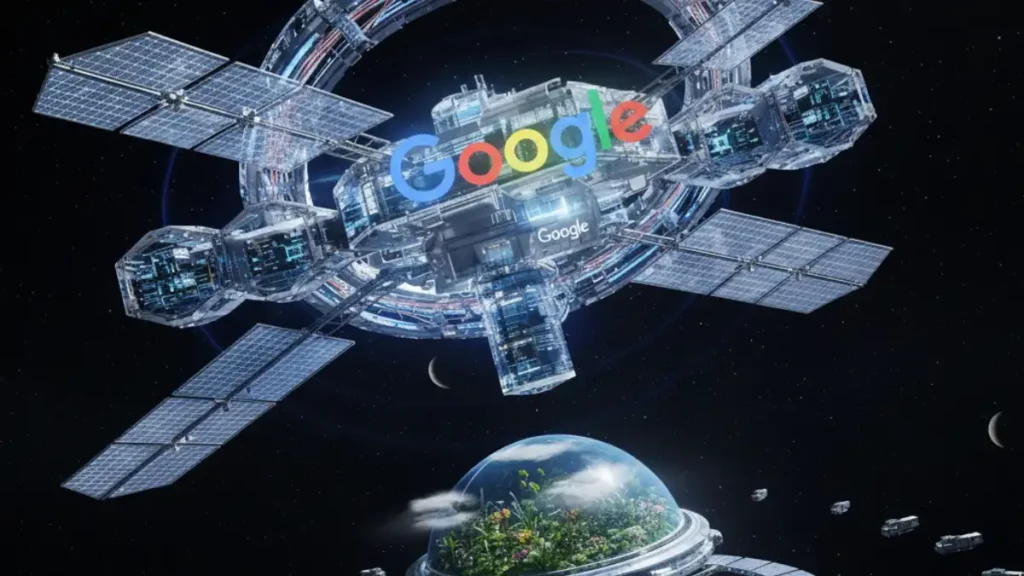
Google is officially taking the AI arms race into the exosphere.
In a move that sounds like a rejected science-fiction script, Google has announced a new research initiative, “Project Suncatcher,” to build AI data centers in space! This isn’t a joke; it’s a massive, multi-year strategic gamble to transform how machine learning compute is scaled.
The concept envisions constellations of solar-powered satellites, each carrying Google’s Tensor Processing Units (TPUs). Alphabet CEO Sundar Pichai hailed the project, stating they expect to launch two prototype satellites by early 2027.
This move is a direct, desperate attempt to secure the energy and resources needed to fuel the company’s monstrous AI models. But the potential consequences—from space debris to a militarized AI race—are terrifying.
The data center is leaving Earth, and the risks are higher than ever 👇
⚡ The Energy Crisis: Why Space Is the Only Answer
Google’s plan is driven by one simple, massive bottleneck: Earth is running out of power for AI. The energy demands of Generative AI models are growing exponentially, and terrestrial resources are limited.
☀️ Unlimited, Free Solar Power
Google’s argument centers on energy abundance and efficiency.
- Ultimate Source: The sun emits “more power than 100 trillion times humanity’s total electricity production”.
- Peak Efficiency: In the right orbit, a solar panel can be up to eight times more productive than on Earth and produce power nearly continuously.
- Resource Avoidance: Scaling AI compute in space also minimizes the impact on increasingly strained terrestrial resources.
Google is essentially creating a perpetual motion machine for its AI, bypassing the political and logistical nightmare of building new power plants on Earth. This gives them an unbeatable competitive advantage.
⚙️ The Hardware Gauntlet
The hardware involved is just as insane. The plan uses Trillium-generation TPUs (Tensor Processing Units)—the same purpose-built chips that power their earthbound AI infrastructure.
- Survival Test: Early research shows these TPUs survived testing in a particle accelerator, simulating the high-radiation levels of low-earth orbit.
- Design Strategy: The strategy focuses on a modular design of smaller, interconnected satellites, making the system highly scalable—a clear blueprint for future expansion.
⚠️ The Terrifying Risks: A Militarized AI Race
While the engineering ambition is impressive, the shift of core computational infrastructure to space raises existential geopolitical and environmental risks.
🛰️ Space Debris and Orbital Pollution
The plan involves launching constellations of satellites—a move that exponentially increases the problem of orbital pollution and space debris.
- Collision Risk: Adding thousands of data-center satellites to already crowded low-earth orbit (LEO) dramatically increases the risk of collisions, which could generate more debris and make certain orbits unusable for everyone.
- The New Arms Race: The fact that the most powerful AI is moving into orbit immediately raises the stakes for military and surveillance capabilities. Which nation will tolerate a rival’s AI “brain” operating freely over its airspace? This technology is instantly weaponized by its location.
🔒 The Corporate Lock-Down
This project is not about helping humanity; it’s about corporate dominance.
- Exclusive Power: By moving its core compute capability to an exclusive, self-sufficient infrastructure, Google is further locking down its lead in AI research, making it impossible for smaller companies or even rival nations to catch up.
- Control of Information: Whoever controls the fastest, most powerful AI infrastructure effectively controls the future of global information and scientific discovery.
This move is an aggressive act of technological secession from terrestrial governance.
💬 Final Thoughts — A Dangerous, Exciting Future
Google’s Project Suncatcher is either the most brilliant engineering feat of the century or the beginning of a massive, uncontrollable geopolitical and environmental disaster.
The core necessity is clear: AI is too hungry for Earth to handle. By moving to space, Google aims to “unlock its fullest potential”.
But potential comes with cost. The world needs to rapidly establish a framework of space governance and ethics before the scramble for solar-powered TPUs turns into a full-blown orbital AI Cold War.

Pravin is a tech enthusiast and Salesforce developer with deep expertise in AI, mobile gadgets, coding, and automotive technology. At Thoughtsverser, he shares practical insights and research-driven content on the latest tech and innovations shaping our world.