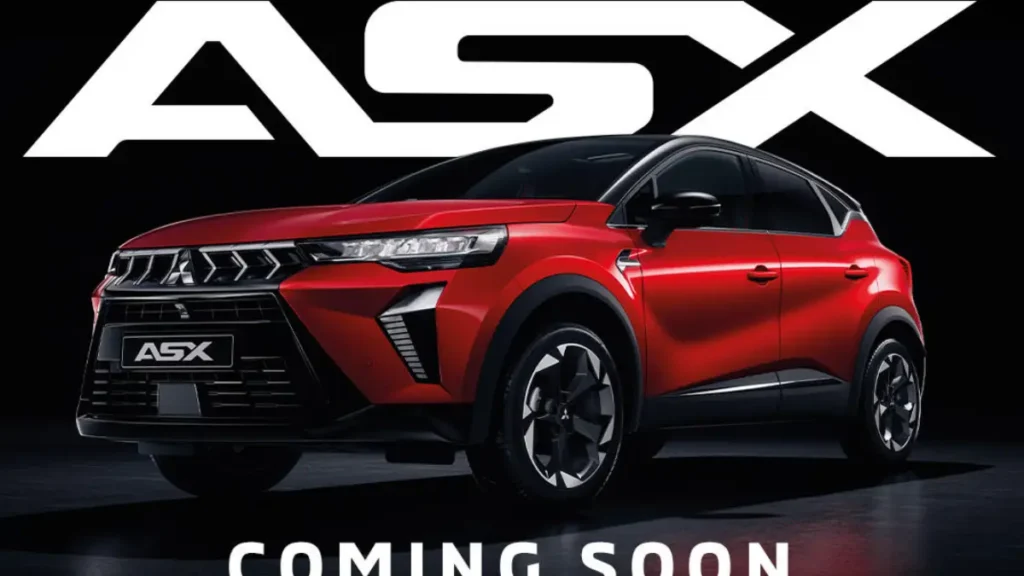
I really wanted to like the 2026 Mitsubishi ASX.
It’s one of those compact SUVs that, on paper, looks like a solid everyday choice — practical, efficient, and affordable.
But after driving it, testing it, and seeing what Mitsubishi actually did with this update… I’m honestly disappointed.
Because this isn’t just a small misstep.
It’s a textbook example of what NOT to do when updating a car in today’s market.
Let’s break down what went wrong 👇
🚘 The Rebadge Nobody Asked For
The biggest issue? The 2026 Mitsubishi ASX isn’t really a new car at all.
It’s a rebadged Renault Captur — same chassis, same interior, same everything, except for the badges and a slightly tweaked front bumper.
Mitsubishi didn’t just borrow parts — they practically copy-pasted an entire model.
And while the Captur is a fine car on its own, calling this a “new ASX” feels lazy.
If you’re expecting Mitsubishi’s signature rugged design and build quality — this isn’t it.

⚙️ Powertrain: Average at Best
The ASX lineup offers three powertrains —
- a 1.0-liter turbo,
- a 1.3-liter mild hybrid, and
- a 1.6-liter full hybrid.
Sounds like a good range, right?
But the reality is… none of them stand out.
The 1.0-liter is underpowered for anything beyond city driving.
The 1.3 mild hybrid has a clunky dual-clutch gearbox.
And while the 1.6 hybrid is smooth, it’s not particularly efficient — you’ll struggle to beat 45 mpg in mixed driving.
Mitsubishi had the perfect chance to introduce a plug-in hybrid ASX or even an all-electric option — but didn’t.
In 2026, that’s a massive missed opportunity.

🧱 Interior: Where’s the Mitsubishi DNA?
Step inside, and it’s clear this isn’t the Mitsubishi we remember.
The cabin is almost identical to the Renault Captur, right down to the center console, infotainment layout, and switchgear.
You get a 9.3-inch touchscreen, wireless Apple CarPlay, and a digital instrument cluster — which are all fine —
but the materials feel generic, not premium.
The door panels are hard plastic, the steering wheel feels too light, and even the seats lack proper bolstering.
To make it worse, the ASX interior doesn’t carry any signature Mitsubishi touches — no robust design cues, no adventure feel, no soul.
It’s just… fine.
And that’s exactly the problem.

📦 Practicality & Space
Now, to give credit where it’s due — the ASX is practical.
Rear seat legroom is good for a subcompact SUV, and the boot capacity ranges from 422 to 440 liters, depending on the version.
Fold the seats flat, and you’ve got decent cargo space for family use.
But again — that’s just the Captur’s design working here, not Mitsubishi innovation.
If you’ve driven the Renault, you’ve already experienced this exact practicality.
💡 Features & Tech
Here’s where things get confusing.
Mitsubishi advertises the ASX as “feature-rich,” but most of those features are optional on lower trims.
You only get the good stuff — adaptive cruise control, blind spot monitoring, 360° camera — on the top trim.
Entry-level versions? Pretty barebones.
For a brand trying to reestablish itself in Europe, that feels like the wrong move.
Rivals like Kia Stonic and Hyundai Bayon offer better tech at lower prices.
🧭 Driving Impressions
On the road, the ASX feels perfectly competent — but totally uninspiring.
The steering is light and accurate but lacks feedback.
The suspension is soft, which makes city driving comfortable, but at higher speeds, it feels floaty.
The hybrid system transitions smoothly between petrol and electric modes, but performance is modest — 0 to 100 km/h takes about 10.5 seconds.
Not bad, but not exciting either.
In short: it’s a decent commuter car, but not one you’ll ever want to drive.
💸 Pricing & Value
Depending on the market, the 2026 ASX starts at around €26,000–€33,000 (roughly $28,000–$35,000 USD).
That puts it dangerously close to better-equipped rivals like the Toyota Yaris Cross and Mazda CX-30.
And those two offer something the ASX doesn’t — character and brand confidence.
Mitsubishi’s pricing would’ve made sense if this car brought something fresh to the table.
But as a badge-engineered Renault, it feels overpriced for what it is.
⚠️ Final Thoughts — A Step Backward for Mitsubishi
The 2026 ASX isn’t a terrible car — it’s safe, efficient, and practical.
But it’s also completely forgettable.
This isn’t what Mitsubishi needs right now.
The brand that gave us icons like the Pajero, Lancer Evolution, and Outlander PHEV should be innovating — not recycling.
If you’re looking for a small SUV, you’re better off buying the Renault Captur it’s based on.
It’s cheaper, identical in design, and doesn’t pretend to be something it’s not.
So, as much as I wanted to like the new ASX…
this one’s a swing and a miss for Mitsubishi.

Pravin is a tech enthusiast and Salesforce developer with deep expertise in AI, mobile gadgets, coding, and automotive technology. At Thoughtsverser, he shares practical insights and research-driven content on the latest tech and innovations shaping our world.